
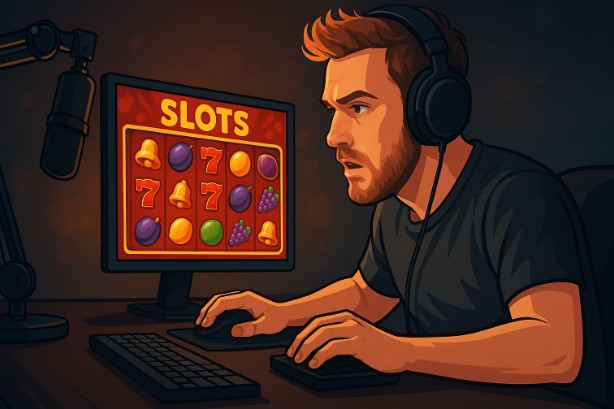

When Trainwreck streams slots, he isn’t gambling. He’s performing. The money isn’t his—it’s “fill money” credited by the casino. The losses aren’t real, but the commission on viewers’ losses certainly is. Last year, he claimed to have wagered $1.85 billion. Even if that number is inflated, the mechanics behind it reveal an industry that operates nothing like most people imagine.
The Twitch gambling ecosystem moves hundreds of millions annually through a web of affiliate deals, flat-rate sponsorships, and revenue shares that streamers desperately try to keep opaque. But pieces of the puzzle emerge through leaked contracts, inadvertent admissions, and streamers who’ve left the space and decided to talk.
The Three Tiers of Gambling Money
Not all gambling streamers are created equal. The industry operates on three distinct tiers, each with radically different economics:
Tier 3: The Affiliates (10-500 concurrent viewers) These streamers get standard affiliate deals—typically 20-40% revenue share on losses from players they refer. No upfront money, no fill money, often gambling with their own funds hoping affiliate commissions cover losses. A streamer with 100 concurrent viewers might generate $2,000-10,000 monthly, depending on their audience’s gambling appetite.
Tier 2: The Sponsored (500-5,000 concurrent viewers) Here’s where real money enters. These streamers receive:
- Fill money: $10,000-100,000 monthly to gamble with on stream
- Flat fee: $20,000-75,000 monthly for streaming quotas (usually 30-50 hours)
- Revenue share: 15-25% of net gaming revenue from referrals
- Keep winnings: Usually capped at 10-20% of fill money
A mid-tier streamer with 2,000 concurrent viewers can pull $50,000-150,000 monthly between flat fees and revenue share.
Tier 1: The Whales (5,000+ concurrent viewers) The mathematics here become staggering:
- Fill money: $1-5 million monthly (sometimes more)
- Flat fee: $100,000-1 million monthly
- Revenue share: 20-50% of NGR, sometimes with no negative carryover
- Special deals: Equity stakes, custom games, exclusive territories
The Trainwreck Model
Trainwreck (Tyler Niknam) represents the apex predator of gambling streaming. His deal with Stake, while never officially confirmed, has been partially revealed through his own statements and industry sources. Here’s what we know:
He claims to receive $1 million weekly in fill money. That’s $52 million annually just to gamble with. But the real money comes from revenue share. In a leaked Discord conversation, he mentioned making $360 million from Stake. Even if that’s lifetime earnings over multiple years, it suggests monthly income in the tens of millions.
The structure reportedly works like this: Trainwreck gets a percentage of net gaming revenue from every player who signs up through his links or codes. With 40,000+ concurrent viewers and conversion rates around 2-3%, that’s potentially 1,000 new depositors per stream. If each loses an average of $500 (industry estimates suggest it’s higher), and he gets 25% revenue share, that’s $125,000 per stream just from new players.
But the genius is in the lifetime value. Players who sign up through Trainwreck keep generating commission for him forever. A problem gambler who loses $50,000 over two years might generate $12,500 in commission—from a single sign-up.
The Hidden Clauses Nobody Mentions
Leaked contracts and streamer admissions reveal standard clauses that fundamentally change the nature of these arrangements:
The Clawback Clause If a player wins big, those winnings often count as negative revenue against the streamer’s share. One massive winner can wipe out months of commissions. Some deals include “no negative carryover” protecting streamers from this, but those are rare and expensive.
The Non-Disparagement Agreement Streamers can’t criticize the casino, discuss withdrawal issues, or mention competing sites. Violation means immediate termination and often clawback of previous payments. This is why sponsored streamers never acknowledge the delayed withdrawals their viewers complain about in chat.
The Exclusivity Trap Most contracts ban streamers from gambling on any other platform, even with their own money, even off-stream. Some extend this to family members. One leaked contract included a two-year non-compete after termination.
The Content Rights Transfer Casinos often gain perpetual rights to stream footage, allowing them to create marketing materials forever. Streamers who try to scrub their gambling history discover the casino owns their content.
The Fill Money Shell Game
Fill money—the credits casinos give streamers to gamble with—operates under specific restrictions that viewers never see:
- Withdrawal Limits: Streamers can typically withdraw only 10-20% of their fill money monthly, regardless of winnings
- Wagering Requirements: Often 3-5x playthrough before any withdrawal
- Game Restrictions: High-RTP games frequently banned; streamers pushed toward volatile, viewer-friendly slots
- The Reset: Accounts often reset monthly, meaning any unwithdrawn balance disappears
This creates perverse incentives. Streamers make reckless bets not because they’re degenerate gamblers, but because the money evaporates anyway. The spectacular wins and losses that generate clips and views are manufactured by the economics of fill money.
The Affiliate Layer Cake
Beyond direct sponsorships, successful streamers build multi-layer affiliate networks. Here’s how one prominent streamer (who requested anonymity) structured their operation:
Primary Layer: Direct signups through stream links – 35% revenue share
Secondary Layer: Other streamers recruited as sub-affiliates – streamer keeps 10% of their earnings
Tertiary Layer: Discord and Telegram groups where moderators share links – 5% override
The Kickback Scheme: Offering players cashback funded by commission, technically violating most casino terms
This streamer showed me a dashboard indicating $2.3 million in monthly gross gaming revenue across their network, generating roughly $800,000 in commissions. Their actual streaming generates maybe 30% of this—the rest comes from the network effect.
The Viewer-to-Player Pipeline
The conversion funnel from viewer to depositor is more sophisticated than most realize. Streamers don’t just display a link and hope for clicks. The process is carefully orchestrated:
First, the streamer hits a big win. Chat explodes. The streamer mentions their exclusive bonus code—”better than what regular players get.” Viewers curious about the casino search for reviews and find sites like Casino Whizz that provide detailed breakdowns, payment methods, and bonus comparisons. But here’s what viewers don’t realize: many review sites share the same affiliate networks as streamers, creating an echo chamber of promotion.
The viewer signs up, often through the streamer’s link to get the “exclusive” bonus. They deposit, usually losing within hours. The streamer gets their cut. The casino gets a new customer with a statistically predictable lifetime value. The cycle continues.
The Real Revenue Breakdown
Based on leaked information and industry sources, here’s what different tier streamers actually make:
Small streamer (100 viewers):
-
Affiliate only: $2,000-5,000/month
-
Expenses: Often gambling with own money
-
Net: Often negative until established
Medium streamer (1,000 viewers):
-
Flat sponsorship: $30,000/month
-
Fill money: $50,000/month (keep 10%)
-
Revenue share (25% of NGR): $20,000/month
-
Total: $55,000/month
Large streamer (10,000 viewers):
-
Flat sponsorship: $500,000/month
-
Fill money: $2 million/month (keep 15%)
-
Revenue share (40% of NGR): $800,000/month
-
Total: $1.6 million/month
Mega streamer (40,000+ viewers):
-
Flat sponsorship: $1 million+/month
-
Fill money: $4 million+/month (keep 20%)
-
Revenue share (45% of NGR): $5-10 million/month
-
Total: $7-12 million/month
The Viewer Acquisition Math
Casinos aren’t stupid. They pay these astronomical sums because the return on investment works. Here’s the brutal math:
Average viewer conversion rate: 2-3% Average deposit: $250 Average lifetime loss: $2,000-5,000 Casino’s gross margin after streamer commission: 50-75%
A streamer with 10,000 concurrent viewers might generate 250 new depositors monthly. At $3,000 lifetime value each, that’s $750,000 in expected losses. Even giving the streamer 40% ($300,000), the casino profits $450,000 monthly from that single stream.
Scale this across hundreds of streamers and the economics become clear. Stake alone is estimated to spend $100 million annually on streaming sponsorships but generates billions in revenue.
The Exit Problem
Streamers who want to leave gambling face a brutal reality. Their audiences are conditioned for gambling content. Switching to gaming might retain 20% of viewers. The income drop is even steeper—from millions to maybe tens of thousands monthly.
Several prominent streamers have tried to quit, only to return months later. The official story is always “the community wanted it back.” The real story is that replacing seven-figure monthly income is nearly impossible.
One former gambling streamer told me: “I calculated I’d need to stream regular content for 15 years to match what I made in one year of slots. The golden handcuffs are real.”
The Regulatory Vacuum
These operations exist in a regulatory blind spot. Streaming platforms ban gambling in some jurisdictions but not others. Casinos operate from offshore locations beyond regulatory reach. Streamers claim they’re entertainers, not advertisers, skirting disclosure requirements.
The few attempts at regulation have been toothless. Twitch’s gambling restrictions simply pushed streamers to Kick, a platform allegedly funded by Stake specifically to host gambling content. Disclosure requirements are routinely ignored or minimized to tiny text nobody reads.
The Endgame
The gambling streaming economy is unsustainable in its current form. Viewer fatigue is setting in—Trainwreck’s viewership has declined 30% from its peak. Regulatory pressure is building; several countries are considering outright bans. Most critically, the player acquisition cost is rising as the easily convertible audience gets tapped out.
But the model won’t disappear—it will evolve. Virtual reality gambling streams are already being tested. AI streamers that never sleep and never complain about fill money restrictions are in development. The next generation of deals will be more complex, more hidden, and likely more lucrative for the few who remain at the top.
The numbers revealed here are staggering, but they’re also conservative. The real figures—the actual contracts, the true revenue shares, the full network effects—remain closely guarded secrets. What we can see is merely the tip of an iceberg that extends deep into the murky waters of online gambling.
Every viewer thinking “just one deposit to try it” should understand: they’re not supporting their favorite streamer. They’re feeding a system where their losses become someone else’s millions. The house always wins, but in gambling streaming, the house has a partner taking a cut of every loss.
That’s the deal. Those are the numbers. The only question is whether knowing them changes anything.
